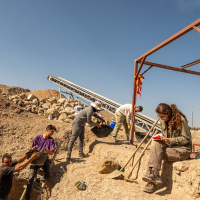
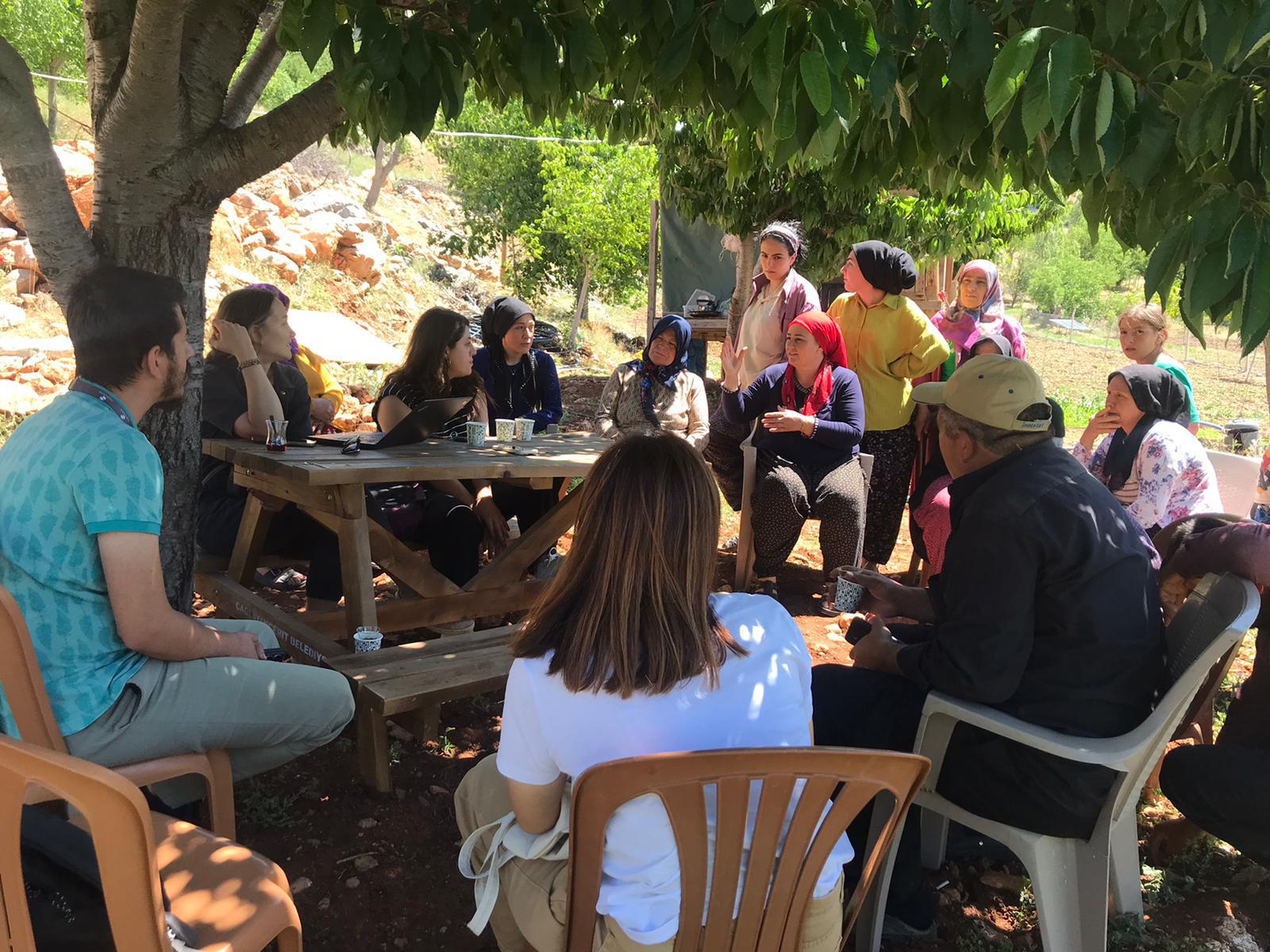
Climate change is no longer an abstract concept; it is a drying well in Adıyaman, an elderly farmer in Hatay longing for the snow that once fell in winter. During my field visit to southeastern Turkey, I sought to understand how local communities in earthquake-affected regions are experiencing the impacts of climate change and coping with these effects. Together with my colleague Semiha İnal, we visited rural areas in Adıyaman, Hatay, and Kahramanmaraş, conducting focus group interviews with local farmers.
We organized these field visits as part of a project we are implementing with the support of DKH (Diakonie Katastrophenhilfe) under the Hayata Destek Association. The common thread among the three provinces is not only that they were affected by the February 6 earthquakes, but also that their economies, particularly in rural areas, depend on agriculture, and these regions are currently facing an unprecedented water crisis.
Frankly, I had expected that the focus of these visits would be on the recovery efforts following the earthquake rather than climate change. I was wrong; climate change is not just one of the priorities for these communities—it is at the very center of their daily lives. Many of the people we spoke with linked environmental degradation, fossil fuel use, and consumption patterns to climate change. This awareness is both encouraging and thought-provoking.
In interviews with over 60 people in five different villages, we received a very clear message: climate change is not a distant threat; it is today's reality. It directly affects people's lives and livelihoods. Local communities no longer want to wait; they are demanding action and the development of sustainable solutions.
The Loss of Seasons and the Water Crisis
Everyone we spoke with described the impact of changing climate conditions on their lives in similar terms: less rain, more drought, hotter days, and almost no snow. Water is now a serious source of stress for everyone.
A participant in Kahramanmaraş described the changes they have witnessed as follows:
“Thirty years ago, winter lasted six months. Now winters are shorter and warmer, and summers are even hotter. We can no longer tell when one season ends and the next begins.”
These words were quite meaningful to me. I too experienced the four seasons distinctly in my childhood, but now this cycle has been disrupted.
In Hatay, a community leader says, “When I was 20, it would snow nearly a meter—even in southern Turkey.” Another person from Kahramanmaraş recalls, “We would collect snow and make ice cream.” Yet now, snow hardly ever falls in these regions.
Snowfall is not merely a nostalgic memory; it is also a natural resource of critical importance for agriculture, storing water throughout the winter and releasing it slowly in the spring. The disruption of this natural cycle is having a serious impact on agricultural production.
These accounts align with Turkey’s national climate projections. The Turkey Climate Change Adaptation Strategy and Action Plan indicates that temperatures will rise further and that sudden, unpredictable rainfall will occur alongside prolonged droughts. Under these conditions, maintaining agricultural production becomes much more challenging.
Food Security at a Breaking Point
Climate change seriously threatens agricultural productivity. Seasonal shifts, prolonged droughts, and sudden floods are making food production difficult and threatening livelihoods in rural areas.
Many young people are no longer interested in farming. They are migrating to cities because they see no future in rural areas. However, this rural-to-urban migration is creating new challenges, especially in regions where earthquake-damaged urban infrastructure has yet to recover. Access to services in urban centers is becoming increasingly difficult, and social vulnerability is growing.
The Goal is Adaptation, the Result is Loss
Farmers are doing everything they can to survive. They are digging wells, turning to drought-resistant seeds, using more chemical fertilizers, and sometimes even forced to sell their most valuable asset—their land.
However, while these strategies may offer short-term solutions, they can lead to new problems in the long run. This is referred to as maladaptation—meaning that steps taken to adapt end up causing more harm in the medium and long term.
A farmer in Hatay shares his perspective: “Everyone is digging wells. But the groundwater will eventually run out.”
While wells may seem like a solution, overuse is depleting water resources.
Land sales are similar; they may provide temporary relief for farmers, but often these lands are used for non-agricultural purposes, further weakening the rural economy.
As Hayata Destek, we focus on approaches that better analyze climate vulnerabilities and integrate local knowledge to reduce these risks of incompatibility. Through our support for strengthening local communities in post-disaster recovery and disaster preparedness efforts, we encourage local communities to develop their own long-term adaptation strategies that are context-sensitive and environmentally friendly. Increased support of this kind is vital to reducing the risks that threaten the present and the future.
A New Approach Is Needed
Continuing with conventional methods is no longer possible. The crisis we face is not only climate-related; it also has social, economic, and humanitarian dimensions. On top of the destruction caused by the earthquake, we are facing a crisis such as climate change, which is slow to progress but deeply affects our lives in many ways.
The solution must come from local communities, but support systems must be strong. It is critical that local people have access to information, tools, and skills to adapt in ways that are sustainable and do not exacerbate vulnerabilities.
At Hayata Destek, we view climate change not merely as an environmental issue, but as a multidimensional crisis that affects the lives, livelihoods, and well-being of the communities we support. This crisis increases humanitarian needs, triggers forced migration, and deepens gender inequalities. Therefore, our solutions must be comprehensive and multi-layered.
We are expanding our experience in responding to climate-induced disasters in line with the new realities we encounter in the field and the risks we identify. In addition to disasters such as earthquakes, forest fires, and floods, we are combining our work in community-based disaster risk management with a climate crisis adaptation perspective.
More effort, more work, and more support are needed to enrich and disseminate the valuable work being done. Let us not forget that the longer we wait, the more difficult and costly it will be to find solutions.
*The Turkish version of this article was first published on bianet on August 9, 2025.
Ayşe Koçak
Disaster Risk Reduction and Climate Change Manager
Thank you for reading the article and for coming this far. Now you can support life while you are here.